

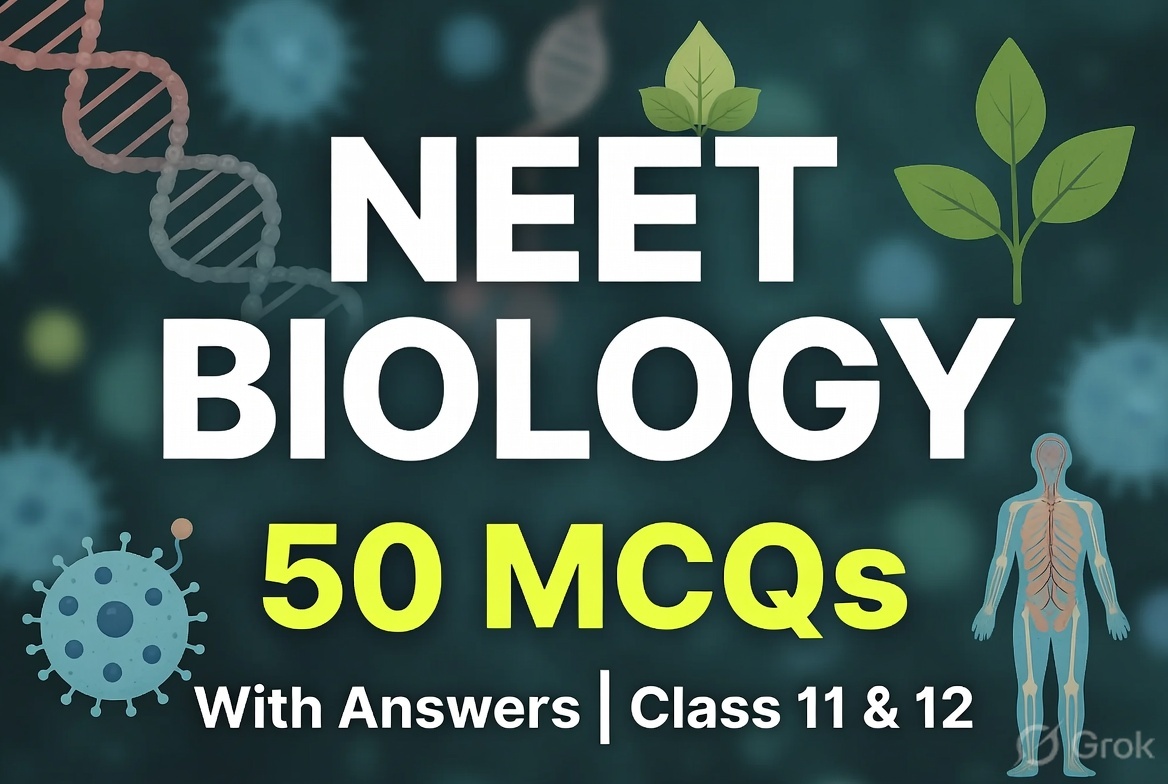
50 NEET-level Biology MCQs
based on NCERT Class 11 & 12 syllabus

Here are 50 NEET-level Biology MCQs (based on NCERT Class 11 & 12 syllabus, covering Diversity, Cell Biology, Physiology, Genetics, Reproduction, Ecology, etc.). Each has four options and the correct answer marked.
1–10: Diversity in the Living World / Taxonomy
1. Compared to genus, which is less general in characters?
(a) Family (b) Species (c) Division (d) Class
Answer: (b) Species
2. Correct combination for wheat is:
(a) Genus Triticum, family Poaceae, order Poales, Class Monocotyledonae
(b) Genus Triticum, family Poaceae, order Poales, Class Dicotyledonae
(c) Genus Triticum, family Anacardiaceae, order Poales, Class Monocotyledonae
(d) Genus Triticum, family Poaceae, order Sapindales, Class Monocotyledonae
Answer: (a)
3. The correct sequence of taxonomic categories is:
(a) Species → Genus → Order → Phylum
(b) Species → Order → Genus → Kingdom
(c) Genus → Species → Order → Kingdom
(d) None of these
Answer: (a)
4. Which category has real existence?
(a) Species (b) Genus (c) Kingdom (d) Phylum
Answer: (a) Species
5. A true species comprises a population that is:
(a) Interbreeding (b) Sharing the same niche (c) Reproductively isolated (d) Feeding on the same food
Answer: (c) Reproductively isolated
6. ICBN stands for:
(a) International Code of Botanical Nomenclature
(b) Indian Congress of Biological Names
(c) International Congress of Biological Names
(d) Indian Code of Botanical Nomenclature
Answer: (a)
7. One of the first acts in taxonomy is:
(a) Identification (b) Description (c) Naming (d) Classification
Answer: (a) Identification
8. The common characteristics between tomato and potato are maximum at the level of:
(a) Family (b) Genus (c) Division (d) Order
Answer: (a) Family
9. A taxon is:
(a) A type of living organism (b) A group of related species (c) A taxonomic group of any ranking (d) A rank in classification
Answer: (c)
10. Nomenclature is governed by universal rules. Which is contrary to the rules?
(a) First word is genus, second is specific epithet
(b) Names are written in Latin and italicised
(c) Biological names can be written in any language
(d) When handwritten, names are underlined
Answer: (c)
11–20: Cell Structure & Function / Biomolecules
11. The plasma membrane is:
(a) Selectively permeable (b) Impermeable (c) Permeable to all substances (d) Made of only proteins
Answer: (a)
12. Which is not a function of the endoplasmic reticulum?
(a) Protein synthesis (b) Lipid synthesis (c) Detoxification (d) Photosynthesis
Answer: (d)
13. Mitochondria are called the powerhouse of the cell because they:
(a) Synthesise ATP (b) Store food (c) Synthesise proteins (d) Help in photosynthesis
Answer: (a)
14. Ribosomes are the site of:
(a) Protein synthesis (b) Lipid synthesis (c) Carbohydrate synthesis (d) DNA replication
Answer: (a)
15. The cell organelle involved in the formation of lysosomes is:
(a) Golgi apparatus (b) Mitochondria (c) Endoplasmic reticulum (d) Nucleus
Answer: (a)
16. Which of the following is a non-membrane bound organelle?
(a) Lysosome (b) Ribosome (c) Vacuole (d) Mitochondria
Answer: (b)
17. The fluid mosaic model of plasma membrane was proposed by:
(a) Singer and Nicolson (b) Robertson (c) Danielli and Davson (d) Overton
Answer: (a)
18. Enzymes are mostly:
(a) Proteins (b) Carbohydrates (c) Lipids (d) Nucleic acids
Answer: (a)
19. The most abundant protein in the animal world is:
(a) Collagen (b) Rubisco (c) Haemoglobin (d) Insulin
Answer: (a)
20. Which of the following is a reducing sugar?
(a) Sucrose (b) Glucose (c) Starch (d) Cellulose
Answer: (b)
21–30: Plant & Human Physiology
21. The process of conversion of atmospheric nitrogen into usable forms is called:
(a) Nitrification (b) Nitrogen fixation (c) Denitrification (d) Ammonification
Answer: (b)
22. C₄ plants differ from C₃ plants in having:
(a) Kranz anatomy (b) Higher photorespiration (c) Only Calvin cycle (d) Lower productivity
Answer: (a)
23. The respiratory quotient (RQ) for carbohydrates is:
(a) 1 (b) 0.7 (c) 0.9 (d) >1
Answer: (a)
24. Which hormone is responsible for closing of stomata?
(a) Auxin (b) Cytokinin (c) ABA (d) Gibberellin
Answer: (c)
25. In humans, the functional residual capacity is:
(a) TV + IRV (b) ERV + RV (c) TV + ERV (d) IRV + ERV
Answer: (b)
26. The pacemaker of the heart is:
(a) AV node (b) SA node (c) Bundle of His (d) Purkinje fibres
Answer: (b)
27. Which of the following is a steroid hormone?
(a) Insulin (b) Thyroxine (c) Estrogen (d) Adrenaline
Answer: (c)
28. The enzyme pepsin digests:
(a) Proteins in stomach (b) Fats in intestine (c) Carbohydrates in mouth (d) Proteins in intestine
Answer: (a)
29. ADH is secreted by:
(a) Anterior pituitary (b) Posterior pituitary (c) Adrenal cortex (d) Thyroid
Answer: (b)
30. The functional unit of the kidney is:
(a) Neuron (b) Nephron (c) Alveolus (d) Osteon
Answer: (b)
31–40: Genetics, Evolution & Reproduction
31. Mendel’s law of independent assortment is applicable for:
(a) Linked genes (b) Genes on different chromosomes (c) Alleles of the same gene (d) Cytoplasmic genes
Answer: (b)
32. The number of chromosomes in human somatic cells is:
(a) 23 (b) 46 (c) 22 (d) 44
Answer: (b)
33. DNA fingerprinting is based on:
(a) Satellite DNA / VNTRs (b) Bulk DNA (c) Only coding sequences (d) Mitochondrial DNA only
Answer: (a)
34. The process of DNA replication is:
(a) Conservative (b) Semi-conservative (c) Dispersive (d) Both a and c
Answer: (b)
35. If the DNA sequence is ATTGCC, the mRNA sequence will be:
(a) ATTGCA (b) UAACGG (c) UGGACC (d) ATCGCC
Answer: (b)
36. The enzyme that joins Okazaki fragments is:
(a) DNA polymerase (b) DNA ligase (c) Helicase (d) Primase
Answer: (b)
37. In humans, sex is determined by:
(a) XX-XY system (b) ZZ-ZW system (c) XO system (d) Haplo-diploidy
Answer: (a)
38. Double fertilisation is characteristic of:
(a) Gymnosperms (b) Angiosperms (c) Pteridophytes (d) Bryophytes
Answer: (b)
39. The primary oocyte is arrested in which stage until puberty?
(a) Prophase I (b) Metaphase I (c) Anaphase I (d) Telophase I
Answer: (a)
40. The hormone responsible for milk ejection is:
(a) Prolactin (b) Oxytocin (c) Estrogen (d) Progesterone
Answer: (b)
41–50: Ecology, Biotechnology & Human Welfare
41. The pyramid of energy is always:
(a) Inverted (b) Upright (c) Spindle-shaped (d) Both a and b
Answer: (b)
42. Which is a secondary pollutant?
(a) CO (b) SO₂ (c) Ozone (d) CO₂
Answer: (c)
43. The term “Biodiversity hotspot” was coined by:
(a) Norman Myers (b) E.O. Wilson (c) Robert May (d) Paul Ehrlich
Answer: (a)
44. Bt cotton is resistant to:
(a) Bollworm (b) Aphids (c) Whitefly (d) All of these
Answer: (a)
45. Restriction enzymes are also called:
(a) Molecular scissors (b) Molecular glue (c) DNA polymerase (d) Ligase
Answer: (a)
46. PCR is used for:
(a) Amplification of DNA (b) Sequencing of DNA (c) Cutting of DNA (d) Joining of DNA
Answer: (a)
47. The causative agent of AIDS is:
(a) HIV (b) HBV (c) Bacteria (d) Plasmodium
Answer: (a)
48. Which of the following is a water-borne disease?
(a) Typhoid (b) Malaria (c) Dengue (d) Filariasis
Answer: (a)
49. The full form of ELISA is:
(a) Enzyme Linked Immuno Sorbent Assay
(b) Enzyme Linked Immuno Sensitive Assay
(c) Enzyme Linked Ion Sensitive Assay
(d) None of these
Answer: (a)
50. In ecological succession, the pioneer community in hydrarch succession is:
(a) Phytoplankton (b) Mosses (c) Lichens (d) Trees
Answer: (a)
Tips for NEET Biology:
Stick strictly to NCERT (most questions are directly or indirectly from it).
Practice previous-year questions (PYQs) regularly.
Focus on diagrams, tables, and examples.
Revise Human Physiology, Genetics, Ecology, and Reproduction thoroughly (high weightage)